Practising art in obscurity: Will AI take over creative jobs?

Updated: Oct 28
I accompanied my partner to an opening at an art gallery late last year; one of his old friends was exhibiting his latest paintings. At one point in the evening I found myself at the edge of the crowd, looking on at the artist with his posse of friends. Like him, they’ve all had careers as creatives. A sober realisation dawned: This will be the last generation to make a living from the Arts.
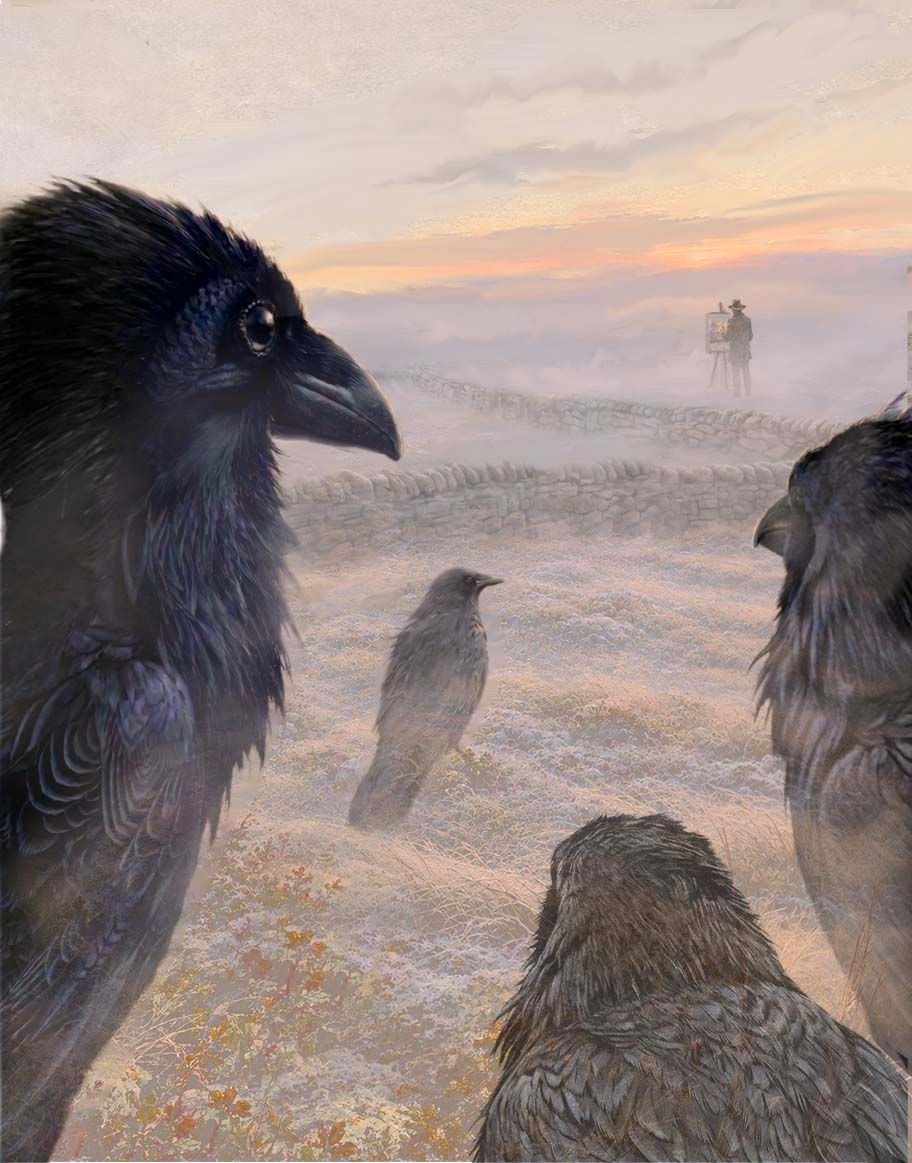
Demise of the ‘commercial’ artist
This piece is not about Fine Arts. It does not go into the trials that painters, sculptors or authors of literary fiction face. Their livelihoods have always been precarious.
I want to focus on the plight of the more commercially-oriented careers in the arts: Illustrators, graphic designers, copywriters and the like, who in our capitalist society (that thrives on advertising) were once not only highly sought after, but also highly paid.
All that has now changed. Many of these folks are struggling to make a living from their craft, and those who still do, know that the end is near.
Death by a thousand cuts
So, what was it that killed the commercial arts? It wasn’t any one thing. Rather, a slow boil, as we transitioned from an analogue world to the digital.
The first major disruption was the personal computer. As it infiltrated the workplace through the 80s and 90s, everyone slowly had to pack away their pencils and paintbrushes, and pick up the mouse. Bespoke hand done illustrations and type became a relic of the past. Desktop design and publishing became the norm. Even photography, which had been steadily displacing illustration, started getting digitised through the 90s. This shift unlocked productivity, changing not only expectations around time to produce creative output but also the price that ought to be paid for it. Unfortunately, quality suffered as well: the advertising posters produced in desktop publishing era for example, has never lived up the beauty and craft that was prevalent in the pre-war and post war era.
Then came the internet and with it image banks like Getty which started compiling and selling tens of thousands of art work, photography and illustration at a minuscule cost. Image banks promised illustrators and photographers lucrative royalties, convincing them to handover their entire portfolio of work–most never saw a single cheque even as the use of stock imagery exploded and become the norm. Most no longer so any point of commissioning bespoke illustration, design or photography. Image banks were never transparent to artists about the extent to which their portfolio had been used or engineered unrealistic usage metrics that would all but ensure that no one got paid. They were the original IP thieves.
Before long platforms like Fiverr entered the foray. Large corporations had been relocating overseas to save on labour costs for decades – business models like Fiverr made labour arbitrage accessible to smaller businesses. Businesses that would have paid $50-$200 to the local graphic designer to do their logo could now use desperately poor artists in Pakistan and get it done for $5. To put things into context, the same gig would have cost $2,500-$5,000 back in the 80s, before adjusting for inflation!
After that came services like Canva that commoditised the very process of design through use of templates and graphic components. This enabled amateurs to mimic trendy designs themselves. Even the desperately poor artist in Pakistan was displaced by their 'freemium' model.
The most recent nail in the design coffin has been generative AI. The release of ChatGPT in November 2022 shook the foundations of many careers in the creative arts. Successive LLMs (large language models) have only gotten better at generating imagery, text and even videos – not that this has helped the public image of AI. Indeed, the community has collectively lashed out at data centres, blatant IP theft and AI-slop that has since flooded the zone. But as old hands who have used AI tools would know, AI-slop is mostly a reflection of the novices who have been using the technology, rather than the fault of the technology itself. In the hands of a master, generative AI is a formidable tool. It remains to be seen whether one day it will be capable of becoming a master in its own right ...
To sum up the career of creatives this past 40 years, 'death by a thousand cuts’ is the phrase that comes to mind.
Closing up shop
My partner, Darren, caught up with old friends he had not seen for a long while that day. Their stories were sobering.
Even the most established among them had closed up shop — Bringing down the shutters on what used to be fulfilling jobs that paid the bills. Some are switching to menial jobs to get by. Their stories are tinged with sadness and nostalgia but there is little regret: They all know that they are the lucky ones who got to live creatively rich lives, earning a living from doing work they loved.
I don’t think anyone there realised that they were amongst the last to have earned a living as creatives. I could not help but wonder: Is this a sign of times to come? Are creatives the tip of the iceberg? Will they be the only profession to suffer the fate of obsolescence thanks to AI? Or will other professions follow?
No one can say.
As historian Yuval Noah Harari often points out, this is the first time in human history that parents have no idea what jobs will be around by the time their children grow up.
Will there be no more artists?
If you ask people in the arts why they pursued a line of work that was amongst the lowest paid and came with the lowest job security, most would answer that they had no choice in the matter:
Practicing their art was something they had to do: It was as innate to them as breathing is to life.
This may sound a tad melodramatic but for a large number of creatives, it is true — and it is precisely this drive to create that will ensure that the artist never dies off, even as the creative profession does.
But what of their art? Will there be an audience to appreciate what they create? Does it even matter?
The celebrity artist
I switched from a lucrative corporate career into the arts in 2020 to pursue a long held dream to be a full time writer. Even then, making a living from books and publishing was next to impossible.
Like the graphic arts, all the value from books has been slowly but surely chipped away by the advent of the Internet, Amazon, big box retailers and all-around poor decision making by large publishers that dominate the industry. Generative AI is just the latest nail on the coffin.
Unless you are a celebrity with a commanding platform, and a legion of dedicated followers, writing books is unlikely to help you pay the bills. Indeed, if you don't arrive with a read-made audience, most publishers won't even give you a publishing contract these days.
Why? Because celebrities, which in today's world means anyone with an audience, have the one thing that ordinary folks don’t – Reach.
The chances of creating reach organically in today's hyper-saturated social platforms is next to none—at least not on existing legacy platforms like Google, Facebook, Instagram or TikTok. The choice most face is to either pay Big Tech monopolies an extortionate economic rent to reach audiences or be confined to obscurity.
The point of practising art
When I first met Darren, he would post all his artwork on Instagram. I could see the many hours of work that went into each of his pieces. I could not fathom why he gave it away to these platforms, for nothing. By this stage, his works were not even reaching the audiences he had spent many years cultivating – None of it made any commercial sense. I remember asking him,
'Why bother creating and posting all your art on Instagram when you get so little back from this platform?'
Darren, as usual, took some time (and prompting) to provide an answer,
'I do my art because I have to. What drives me is a desire to push the boundaries of art, to innovate, to create marks and expressions that I have never been seen before, which invoke feelings I have never felt before. As nice as it would be to be paid for doing this, making a commercial return is not the point. The point is to break new ground and find my inner voice. At the end of the day, I do my art for myself. And when it does reach and speaks to another, that feels like a bonus.'
Darren's illustration practice had always had a commercial bent: He was hired to create visuals to communicate a commercial message to a target audience. In the heyday of illustration (pre the advent of digital technologies) he got paid handsomely for his craft. Being competitive by nature, he also went for and won many local and international design and illustration awards.
None of these however, led to lasting fulfilment; he found himself mentally, physically and spiritually depleted at the end of it. It took many years of deliberate study, practice and inner work to transform what had been an 'extrinsically motivated' illustration practice into an 'intrinsically motivated' art practice.
Practising art in obscurity
Darren's reply has stayed with me since. As I transitioned into the Arts, I too found solace in writing, first and foremost, for myself. To the extent that it reaches and speaks to another, has always felt like a bonus.
I cannot help but think that it is the right attitude for the times – and I know that many artists feel the same.
Confinement to an obscure corner of the internet will not stop them from doing this work: They will create their art, regardless — and the work will continue to enrich their lives. The more pressing question, as we watch AI encroach on our lives and work, is what the rest of humanity will turn toward to enrich theirs?
Listen to Audio . View Video
Written by Reeta Dhar. Cover Art by Darren Pryce.
Written at The Cave in Coogee. Digitally crafted at The Shack in Nambucca.
Revised Edition first published by the Vitalis Magazine in July 2026
Comments